
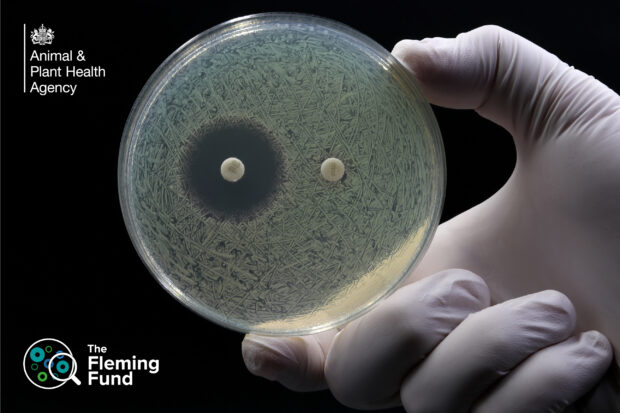
Antimicrobial resistance (AMR) is often called the “silent pandemic”. It affects how well medicines work, not just in hospitals, but in farming, food production and the environment. When antibiotics stop working, infections become harder to treat, food systems become more vulnerable, and risks to human and animal health increase.
Over the past seven years, our team at the UK FAO Reference Centre for Antimicrobial Resistance, has worked with partners across Africa and Asia to help tackle this growing challenge. Supported by the Fleming Fund, we focused on a simple idea: if countries can reliably detect, understand and respond to antimicrobial resistance, they can take action to reduce it.
A defining feature of this work has been close partnership with FAO, whose in-country presence, regional networks, and understanding of national priorities ensured that activities were well aligned, locally relevant, and embedded within existing systems. This enabled more effective delivery and stronger, more sustainable outcomes across the programme.
Building the foundations: better data, stronger systems
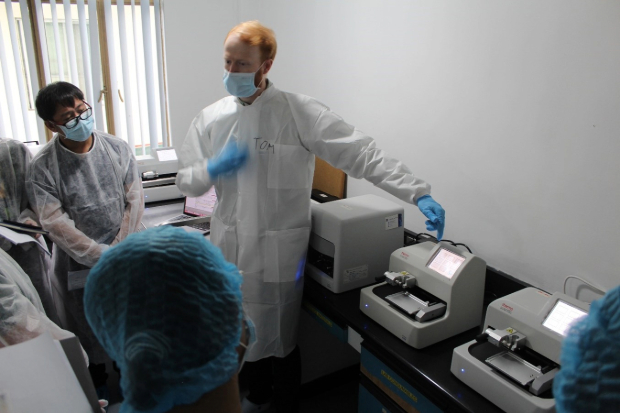
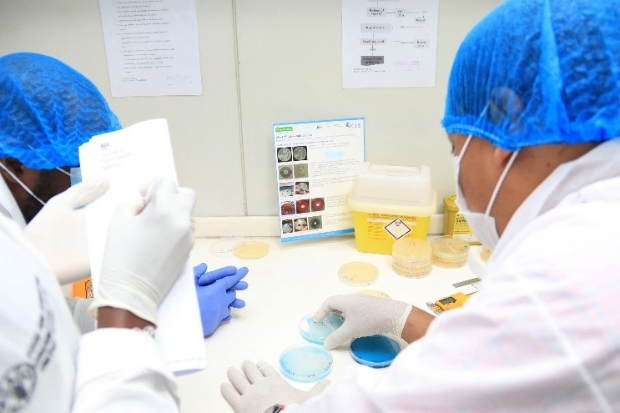
A key part of the work has been strengthening laboratory capacity. In many countries, laboratories faced challenges such as limited equipment, supply issues, and inconsistent testing methods. Through training, mentoring, and quality assurance schemes, we supported laboratories to improve their ability to identify resistant bacteria and produce reliable data.
This matters because good decisions depend on good data. Without knowing where and how resistance is occurring, it is difficult to target interventions or measure progress.
“The training and proficiency testing support from the Reference Centre have strengthened both our technical work, our quality systems and National AMR Reference System for animal health. We now confidently produce reliable AMR data to inform national decision-making.”
Dr. Benjamin Kissi Sasu (National Food Safety Laboratory, Accra, Ghana)
Working with people: from training to global networks
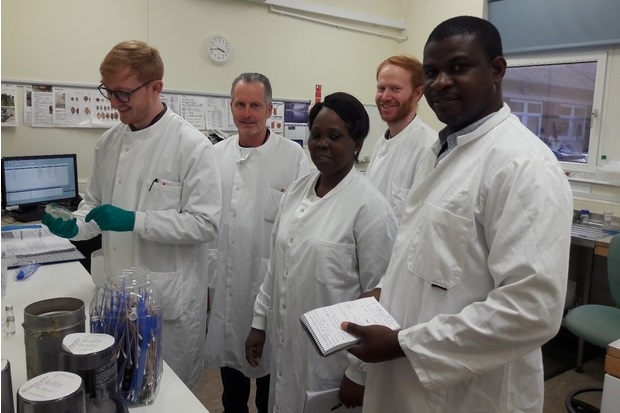
Alongside technical work, we invested heavily in people. Over the course of the programme, we delivered training, hosted scientists in UK laboratories, and supported a growing international community of practice.
Today, that community connects professionals from across the world, creating space for knowledge sharing and collaboration beyond individual projects. This has been essential for building confidence, sharing solutions, and sustaining progress across sectors.
“The UK visits were a valuable opportunity to build new skills and partnerships. We’ve taken what we learned back home and are applying it to strengthen our laboratory work and support others.”
Julius Sombie (Central Veterinary Laboratory, Makeni, Sierra Leone)
Generating evidence to guide action
We also worked with partners on collaborative research to fill important evidence gaps. For example, studies on antimicrobial resistance in poultry systems and aquatic environments have provided new insights into how resistance spreads in food production systems.
These kinds of studies help translate science into policy, supporting countries to shape surveillance systems, national action plans, and regulatory approaches.
“The collaboration with APHA over the past period has given us the opportunity to share findings from Vietnam, as well as to develop future cooperation directions on antimicrobial resistance. Especially, working together on Campylobacter research has improved our understanding of AMR risks in food systems and provided data to support better decisions.”
Dr Luu Quynh Huong (Vietnam Institute of Animal and Veterinary Sciences, Vietnam)
What we have learned
Looking back over seven years, some clear lessons stand out.
First, long-term partnerships matter. Countries that we worked with over multiple years showed the greatest progress, particularly in laboratory quality and surveillance systems.
Second, hands-on support makes a difference. While remote training can be useful, in-country mentoring and practical experience were far more effective in building lasting capability.
Third, strong systems are just as important as individual skills. Laboratory improvements cannot be sustained without reliable supply chains, stable infrastructure, and ongoing investment.
A lasting legacy
Building on seven years of partnership and capacity strengthening, laboratories are better equipped, professionals are better connected, and countries are better positioned to respond to AMR.
The Fleming Fund programme formally concluded in March 2026, but the work of the UK FAO Reference Centre for Antimicrobial Resistance continues.
Looking ahead, we will continue to support countries to strengthen surveillance, translate data into action, and deepen One Health collaboration, ensuring that the progress made evolves into sustained, long-term impact.
Recent Comments