
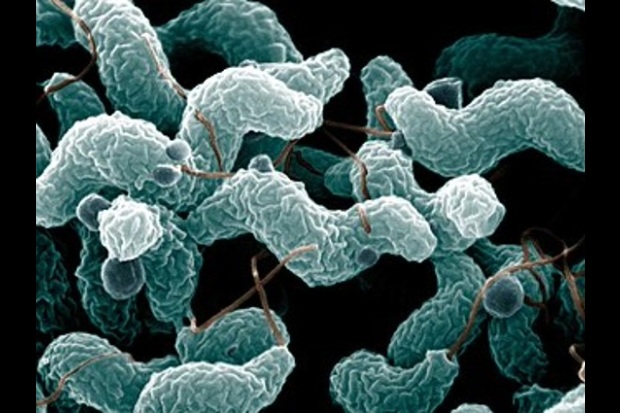
Campylobacter is one of the leading causes of bacterial food poisoning in the United Kingdom (UK), with approximately 70,000 cases being diagnosed each year. This is likely an underrepresentation, as typically Campylobacteriosis only causes a self-limiting infection characterised with frequent diarrhoea, abdominal cramps and fever and may go unreported to health professionals. However, in England, 5-10% of cases require hospital care, with complications arising from the development of several post-acute infection syndromes such as Guillain-Barré syndrome, reactive arthritis, or bacteraemia.
Poultry is recognised as one of the principal sources of human Campylobacter infections, with transmission commonly occurring through the handling and consumption of contaminated poultry products.
Over the past two decades, the poultry industry has introduced numerous interventions, from on-farm biosecurity measures to improved hygiene and processing practices, aimed at reducing Campylobacter contamination throughout the food production chain. Despite these efforts, Campylobacter remains a persistent challenge for the poultry industry.
In conjunction with this, our routine surveillance of Campylobacter over the years has identified an increase in antimicrobial resistance to certain antibiotics used in the treatment of clinical human cases.
Together, the persistence of Campylobacter in the food chain and the emergence of antimicrobial resistance present an ongoing challenge to public health.
The relationship between food production and human health is central to the ‘One Health’ approach, which recognises that the health of people, animals, and the ecosystem is interconnected. Rather than considering these areas in isolation, One Health encourages collaboration across sectors to address shared health challenges.
In the case of Campylobacter, reducing bacterial contamination in poultry products could help lower the risk of human infection. However, achieving this has proven challenging, and no single intervention has been sufficient to eliminate the risk of Campylobacter infection in the UK.
But, what if one way to tackle these harmful bacteria was as simple as switching on a light?
Well, this may not be far from the truth.
Research carried out in collaboration between the Campylobacter National Reference Laboratory at APHA and Aidan Taylor’s group at the University of Reading has been investigating the use of violet-blue light to reduce Campylobacter contamination through a method called violet-blue photodynamic inactivation (VB-PDI). The additional advantage is that 405 nm light does not involve the use of ultraviolet (UV) radiation, potentially offering a more practical alternative for use in certain food-processing environments. However, appropriate safety assessments would still be required before introducing high-intensity lighting systems into workplaces.
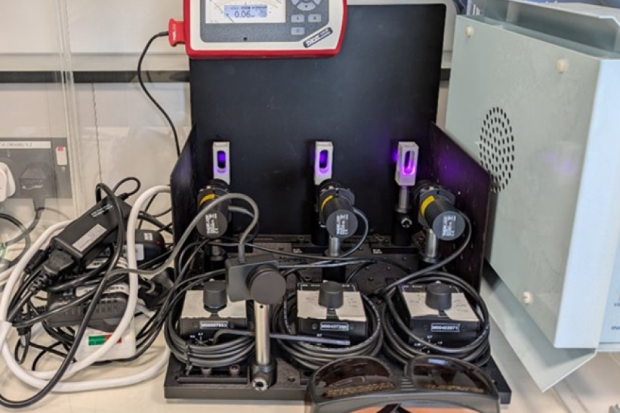
Previous research has shown how effective VB-PDI is against laboratory strains of Campylobacter jejuni where they could achieve a 99.9% reduction in cell numbers within 2-minutes of exposure. This process works by activating naturally light sensitive molecules within bacterial cells, leading to the production of reactive oxygen species. These highly reactive chemicals can damage cellular components such as DNA or proteins, ultimately killing the bacteria.
However, while these findings were promising, several important questions remained. In particular, would VB-PDI be equally effective against the diverse range of Campylobacter species found in the poultry industry?
To investigate this, we selected 64 Campylobacter samples from three species that can cause illness in people: C. jejuni, C. coli and C. lari. These samples represented a wide range of genetic backgrounds and showed different levels of susceptibility to antimicrobial drugs.
Encouragingly, all 64 samples were susceptible to VB-PDI, with broadly similar responses regardless of species or antibiotic resistance. These findings suggest that violet-blue light could provide an effective means of reducing Campylobacter contamination across a diverse range of strains, including those resistant to antibiotics.
It is also pertinent that when developing a new technology, we as scientists ensure that we are not going to generate another problem for future generations to solve.
We have seen how the misuse of antibiotics and other bactericidal compounds can contribute to the development of resistance over time, meaning that infections are harder to tackle. Therefore, assessing how bacteria could develop resistance to violet-blue light is an important part of assessing its potential as a future intervention.
To investigate this, we repeatedly exposed Campylobacter strains to 405nm light, using conditions that killed 99% of the bacterial population. The surviving cells were then allowed to recover, before being treated again. This process was repeated 15 times to determine whether successive exposures could select for bacteria with increased tolerance. We observed no detectable increases in tolerance to VB-PDI. Although this does not rule out the possibility, it does provide encouraging evidence that repeated exposure may not readily select for increased tolerance.
So, what does this mean for the poultry industry?
The findings in this study raise the possibility of using VB-PDI as an additional tool to reduce Campylobacter contamination that may occur during poultry processing. In the future, we envisage specially designed lighting systems that may be implemented at various stages of the food production system, complementing or replacing existing food safety measures. However, further research is needed to establish how effectively this approach works on poultry products and in real processing environments. Factors such as treatment duration, light intensity, coverage of uneven surfaces, and the practical requirements of poultry processing would all need to be considered.
This research highlights the value of bringing together expertise in microbiology, veterinary surveillance and food safety. Through collaboration between APHA and the University of Reading, we have demonstrated that VB-PDI offers a promising approach to tackling Campylobacter, including strains resistant to clinically important antibiotics.
This innovation could provide a new way to tackle Campylobacter, one of the most common causes of food poisoning in people. By helping to prevent or control the bacteria in animals, it could reduce the amount of Campylobacter entering the food chain and therefore lower the risk of infection in people.
Better prevention could also mean less need for antibiotics to treat bacterial infections in both animals and humans. Reducing unnecessary antibiotic use is vital because overuse encourages bacteria to become resistant, making infections harder to treat (AMR).
The innovation therefore supports a One Health approach, recognising that the health of animals, people and the environment are closely connected. By tackling Campylobacter closer to its source, it has the potential to protect human health, improve food safety and contribute to the wider fight against AMR.
While further work is needed before this technology can be introduced into commercial settings, our findings represent an encouraging step towards developing additional tools for controlling foodborne bacteria. By combining innovative research with surveillance and collaboration across sectors, APHA continues to support a One Health approach to protecting people, animals and our shared environment.
Leave a comment